It was a two lap affair, so I got a good
chance to look at some of the other runners on the second lap. I had a healthy
lead, but I ran each mile slightly slower than the one previous. It would have
been nice to have somebody to chase. Crossing the finishing line in 16:55, my
Garmin watch told me that I’d only ran a shade over 3 miles, and not the full
5KM as advertised. Whatever the actual distance was, I felt good, and pleased
that I’d ran fairly strongly – an indication that maybe I might be able to run a
sub-17 mins 5K again one day.
Sunday, 1 December 2013
Hotsu River Charity Run 5KM
The northern bank of the Hotsu River in
Kameoka town was the scene of some charity fundraising running action this
morning. Having only done 2 races in 4 months, I leapt at the chance to test
out how my training is going now that I’m on the comeback trail. My plan was to
treat this as a ‘run through’: just stick to my regular training for this week,
with no race taper, and do this short blast in lieu of a long Sunday run.
Looking around at the runners at the front of
the field on the start line, I was a bit concerned to see dozens of pre-teen
youngsters, until I realised that the 2.5K kids run and 5K were starting
together. After a bit of weaving around flailing youngsters who’d started at a
sprint, I felt pretty good to be out in the lead after 400M. Being a charity
fun run, there was never going to be a strong running field. Most of the first
mile was on a tarmac cycleway, before dropping onto a stone-gravel path around
several rice paddies.
One thing that I noticed during this race is
that marshals and spectators shouted, “Fight-o!”, as I ran along. Japanese
people often use the word “Ganbarimasu” when offering encouragement, which
loosely means “Do your best”, “Struggle to overcome hardship”, or simply “Fight”!
I’m used to people in the UK shouting “Go on!” and “Dig deep!”, but this is an
interesting variant on the theme.
Sunday, 17 November 2013
Kitakuwada Senior High School Marathon
Tradition holds that, in November of each
year, senior high schools (for students aged 15-18) throughout Japan hold a marathon.
Up until about 20 years ago, these races were the full 26.2 miles marathon
distance. Nowadays, most schools have reduced the distance to somewhere in the
region of 15-20KM, but kept the marathon title. All road races in Japan, no
matter what the distance, seem to be called marathons.
I arrived at work on marathon day with an
unusual spring in my step. A few weeks previously, I’d been told that I could
run in the race, the only member of staff to be allowed to do so as the rest
would have marshalling duties, but on the condition that I had to “try and win
it”. This was a 20KM out and back, undulating road race through a rural valley
lined with rice paddies. Every school student was expected to attempt the race,
and given a target time to aim for. If a student failed to complete the race within
the target time, they have to do the race again a few weeks later!
All of the students assembled on the baseball
pitch to listen to a speech delivered by the school Principal, and then took
part in some mass stretching exercises. At the appointed hour, all the male students
gathered quietly on the start line for their 20KM effort. The female students
stood or lounged around watching the spectacle, as they were to have a few
moments reprieve before their 15KM effort kicked-off. As is my wont, I jogged
over to the front of the start line with only a few minutes to spare. Most
students hadn’t realised I was doing the race, and they gave me a spontaneous
round of applause.
When the signal was given to start, the
students surged forward, many sprinting at full tilt. After 400M we left the
school grounds, and I saw one student pull over to the side, bent double and
breathing heavily, paying the price for his early enthusiasm. I could see a
lead pack of a dozen runners some way out in front of me, and I decided to work
slowly at pulling them back, which I did just before the 1st mile,
which we went through in a breezy 5:45.
Settling into the middle of the leading pack,
I counted 9 boys. This pack remained together for the next 3 miles, averaging
6:10 mile pace. Between the 5th and 6th miles, the pack
began to break up, with a few boys drifting off the back. 4 boys stole away
from the rest of the field as they increased the pace once they sighted the
cone in the road that marked 10KM and the turnaround point. We began to pass
runners who were on the other side of the road still on their way out, and
several shouted and waved enthusiastically. Some students were seemingly
astonished that I was with the leading pack, as several pointed at me and
laughed as they shouted “Michael Sensei!”
At 7.5 miles we rounded a sharp, blind bend,
and one student made a sudden break for it. By the time the road straightened,
he already had a 20M lead. I decided to chase him down, and quickly caught him.
By 8 miles, the boy in 2nd place had caught us both. Sadly for him,
he had clearly spent his reserves, and quickly fell back again, never to be
seen again. Mr Y, the race leader, was clearly nervous being out in front by
himself, as he kept on turning his head around to see what was going on behind
him. He ran straight past the final drinks station at 15KM. I slowed for a
quick drink and Mr Y opened up a gap, which he maintained till the finishing
tape.
Turning into the final straight, I tried to look
photogenic as I made a push for the finish area next to the school’s main
entrance, and spotted the Principal stood just a few yards in front of the
line. As I approached him, he stretched out a hand in the unmistakable
international language of “high-5”, which I willingly obliged him with. I think
we must have both had very broad grins on our faces as I crossed the finish line
in 1 hour 18 mins.
Later, I congratulated Mr Y on his win. He
asked me if I’d let him win. I told him that he’d won fair and square. Overall,
I was very impressed with the enthusiasm with which the students approached the
whole event. They seemed really cheerful and happy to participate in what was a
tough race. There was a great atmosphere in the finish area as teachers served
the students bowls of stew and they sat around on benches in front of the
school for a well-earned rest. This was perhaps the best day’s work I’ve ever
had.
Wednesday, 13 November 2013
Veteran
There
comes a time for every runner when, due to advancing years, they leave their
Senior Runner days behind and become a Veteran. In the UK, 40 years of age
traditionally marks this watershed. So I was taken by surprise when I
discovered that, at the tender age of 33, I’m considered to be a Veteran in
Japan.
As
I crossed the finishing line of the recent Kyoto Tamba 5KM Road Race in 4th
place, I’d naturally assumed that, being denied a podium position, any prizes
or glory had escaped my grasp. I quickly got changed, did a few miles easy
jogging, and headed home. Unbeknown to me, a prize ceremony took place whilst I
was jogging around the woods close to the track stadium where the race had finished,
and the prize for the 1st Veteran finisher went unclaimed.
The
results of the race were published in a local newspaper a couple of days later.
I was stopped in the corridor at work by a fellow teacher who congratulated me
and enquired as to what prize I’d received. I had no idea what they were talking
about and told her that as the 4th finisher, I hadn’t won anything.
Later that day, a group of teachers, all of whom had also seen the said
article, discussed the situation and explained to me that I’d won the Veteran
aged 30-49 category of the race and was, therefore, eligible to claim a prize.
Phone
calls were made and a teacher popped out of work on my behalf to the track
stadium, and I was presented with my first ever prize as a Veteran Runner by the
school Vice Principal, to the accompaniment of a round of applause from the
staff still present in the teaching room after the days lessons had concluded. I
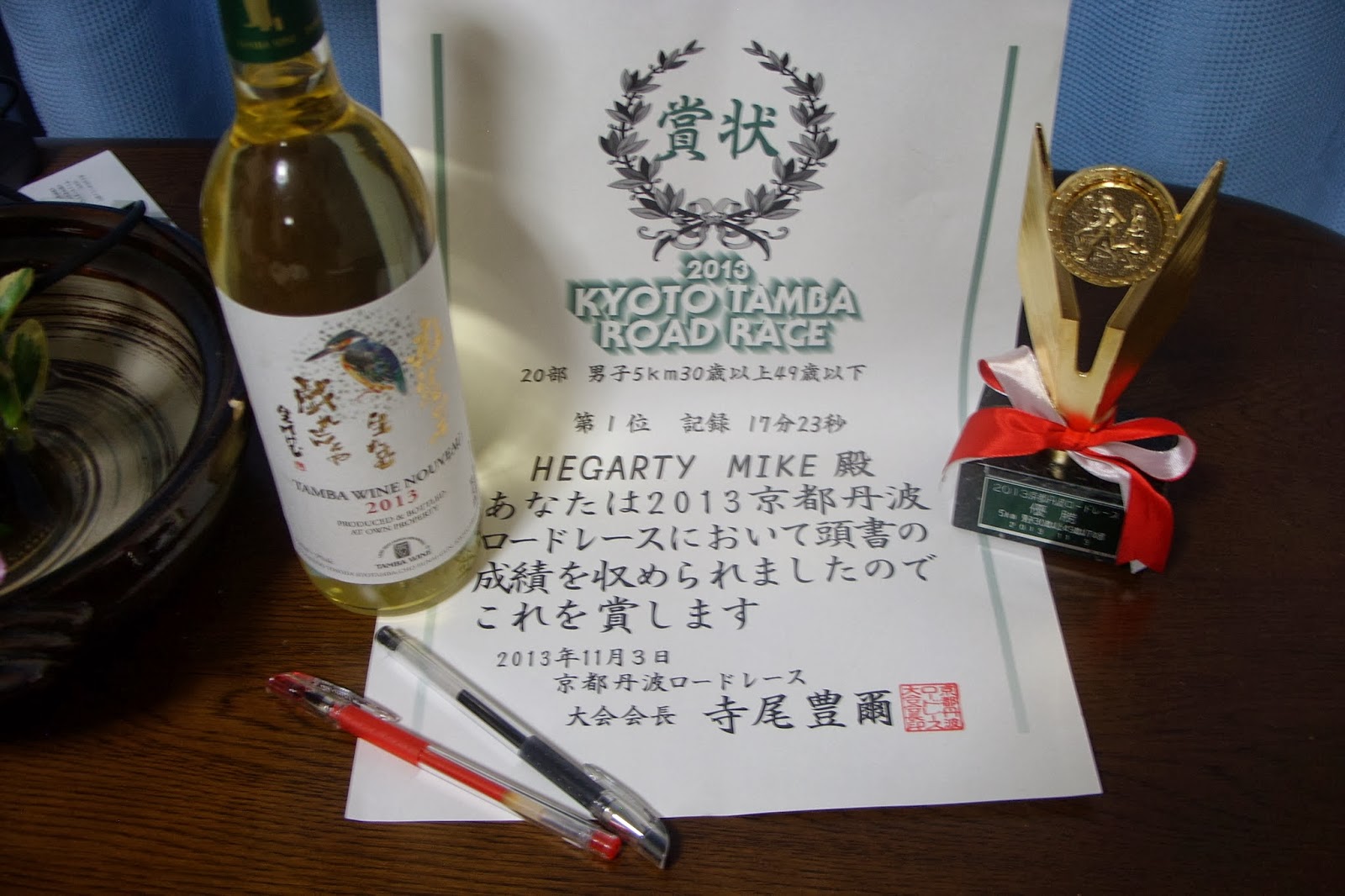
got my first glimpse of the sort of prizes given out to runners in Japan The
haul included a bottle of locally produced wine, a certificate, a trophy and 2
pens. Some runners don’t like being classified as a Veteran, with its
connotations of sunsets and best years being behind you, but I’m not
complaining.
Saturday, 2 November 2013
Kyoto Tamba 5K Road Race
The
Kyoto Tamba 5K was part of a running festival with a range of racing distances
on offer from 3K up to half-marathon. Being my first race in Japan, I was
unsure of what to expect. As the runners lined up before the race, I had my
first chance to look at the competition. There were around 200 runners in this
race, with most people having opted for the half. As I looked ahead from the start
line, I could see that the first 100 metres was straight up a hill which I
couldn’t see beyond, so I decided to take the first stretch at an easy pace.
Predictably
perhaps, many runners surged ahead and
sprinted up the first climb after the starting gun was fired. By the time I crested the hill, some of the early
enthusiasts were already fading back. I glanced around and saw a leading group
of three men to my left beginning to break away from the main field, so I put
in a little surge to latch on to the back of the group as we rounded a bend to
exit the park. There followed a half-mile of steady descent towards the local
town, during which I drew up alongside the lad in third place who was wearing a
white vest and would go on to win the race.
We
then ran through a 600M stretch of the town along a traffic-free side road.
People stood in the entrances of shops and apartment blocks and applauded us as
we sped along and I tried to stay in contact with the leading group. After
about 2KM, the road turned up a 400M sharp climb, during which the leading pack
of three men left me behind. The road soon levelled out again and a man in a
red vest, who’d been leading the race from the gun until this point, had also
been dropped from the front pack, with white vest taking the lead. The
positions remained unchanged until the finish.
Wednesday, 30 October 2013
Fushimi Inari
In whichever direction I look, I
seem to be surrounded by densely forested hills and mountains. I’ve been
looking for a way to venture up into the hills since I arrived in Japan 3
months ago. I asked two different colleagues at work if there were walking
paths into any of the nearby peaks, and they said that they didn’t know.
Undeterred, I ordered the Lonely Planet’s Hiking
in Japan guidebook. I figured that if there are local hikes, it must be
possible to also run some of them as well, which would make for some
interesting off-road long runs.
The first hike listed in the
Kansai area is called Fushimi Inari. It starts at Fushimi Inari Taisha shrine,
which is the most important of more than 30,000 such shrines in Japan that are
dedicated to Inari, the Shinto god of rice. There’s a cobbled street lined with
shops, teahouses and food outlets just next to the shrine. A culinary
speciality of the area is yakitori (grilled
sparrow). Tradition holds that farmers considered sparrows a nuisance and would
roast them as a warning to the ones still flying free. Sadly, there was no yakitori
available when I paid a visit, so I had to settle for the nearest equivalent
– grilled quail.
Fushimi Inari Taisha is best
known for the more than 10,000 bright red torii (shrine gateways) in the forest
behind the shrine. It is possible, if
you choose your route carefully through the maze of torii lined paths, to reach
the summit of Inaria-san, from which you can view Kyoto City in the valley
below. Most visitors only go as far as this, but it’s possible to drop off the
summit into a valley to the north of the mountain. Following a stream through
the forest leads you away from the torii and all the way to Tofuku-ji. This is
the end point of the hike, which takes only a couple of hours. Tofuku-ji is one
of the five great Zen temples of Kyoto, with three gardens that are worth
seeing.
It’s not possible to do this hike
as a run: the route is far too busy with tourists. So in this sense, the reconnaissance
trip was a failure. Yet this day trip ranks as my best day in Japan so far. The
walk is pleasantly relaxing, passing as it does through a beautiful forest
covered mountain and is a chance to escape for a few hours from the hustle and
bustle of Kyoto City. The torii lined path is an iconic image of Kyoto City, if
not Japan. In any case, there are several other hikes in the Kansai area listed
in the book that I intent to check out, some of which are in much more remote
locations than Fushimi, and possibly even runnable.
Sunday, 13 October 2013
Track Training
I
had been hoping to find a tartan track in Japan that I could train on. The
benefits of being able to train on a track are enormous, in terms of being able
to build the speed-endurance needed to set new PBs (personal bests). For the last
two months, I’ve been training on a cinder track about 1 mile away from my
apartment. Although this has been useful, particularly as I've been building up my
base level of fitness, it's not as good as training on tartan. The cinder
track has become rutted in parts due to the typhoon that hit Kyoto Prefecture
about a month ago. Also, it is difficult to run even splits as there are no
track markings every 100M, like you have on a tartan track.
This
week’s track session was a simple 4x1200M reps, with a few striders thrown in. I
can’t get to the nearest tartan track during the week, mainly because it is
locked up at around 5pm. So track sessions will have to be weekend affairs. Friday
evening happened to be my first enkai
(work party) in Japan. It was at a Korean restaurant close to Kyoto City. The atmosphere
was a little stiff and formal at first. Once the beer started flowing, however,
it became a very lively affair indeed. According to some of the travel guides
to Japan that I read before I came out here in August, Japan is often seen as a
rigid, formal society, with Japanese people being largely inscrutable. This is
a picture of Japan that is unrecognisable after attending an enkai. My work colleagues were
incredibly friendly, warm, entertaining and hospitable.
A
track session on Saturday would have been more preferable, but after the
excesses of the work enkai the night
before, I was content with an easy day and an easy run. Heading to Kyoto Tamba
for my first tartan track session this (Sunday) morning, I was a little
apprehensive. I know I’ve gotten fitter and stronger over the last month or so,
but I wasn’t sure of the level that I’d reached. I knew this session would
reveal this and show what I can realistically aim for in my first race in
Japan, which is in 3 weeks’ time.
The
session started well. I was aiming for 80 seconds per 400M lap pace. I did this
comfortably for the first rep. I failed to hit this target for the next three
reps! This was an eye opener. It was hot and I finished the session dehydrated.
However, I can’t blame the weather. I now know that I’m well short of the
fitness standard that I thought I was at and I’m aiming for. Whilst this is
useful to know, it means that I have months of slogging away to try and get
back to the sort of standard where I can start aiming to beat my PBs. This is a
bit daunting, but I’m undeterred. I’ll be back at the track next weekend.
Sunday, 6 October 2013
Osaka
Osaka is the name of the third
most populated city in Japan and the country's second smallest prefecture. It
is also home to an annual autumnal marathon, which was won last year by my fellow
Morpeth Harriers club mate, Serod Batochir, in an impressive time of 2:11:54.
However, it was a castle and beer that drew me to Osaka last weekend, rather
than athletics.
Osaka Castle is the best known landmark of the city. Built at the end of the 16th Century under the reign of Toyotomi Hideyoshi, it was subsequently destroyed twice, by an attacking army in 1615 and consumed by fire when it was struck by lightning in 1665. Rebuilt in the 1930s, a large public park surrounds the castle. After touring the castle battlements, I ate some Takoyaki. This is a well-known dish, associated with Osaka, made out of fried balls of dough, green onion, pickled ginger and octopus.
Osaka Castle Park covers a huge site
and is a great place to run. It is very popular. There were thronging crowds of
day tripping tourists, families, cyclists, baseball players and runners - all
enjoying the delights of this open space in the heart of a vast urban metropolis.
Though the paths were busy, it was possible for me to do an effort session
comfortably around the park. Groups of local runners appear to meet and train
there.
Having worked up a bit of a sweat in
the baking sun, I took a short hop over to Tennoji Park, which was hosting the
2013 Osaka Oktoberfest. This was Osaka’s version of the Munich beer festival in
Germany. There were stalls selling food and beers from numerous countries, to
the accompaniment of music provided by a German folk band. As darkness fell
over the city, I relaxed supping some ale whilst gazing over the dance floor
area in front of the band, which was packed with a multi-national crowd of
bleary eyed revellers.
Subscribe to:
Posts (Atom)